

Singapore Tightens Its Grip on Asia’s Family Office Market
Singapore keeps its lead as Asia's family office hub, balancing generous tax incentives against tougher compliance and rising competition from Hong Kong.

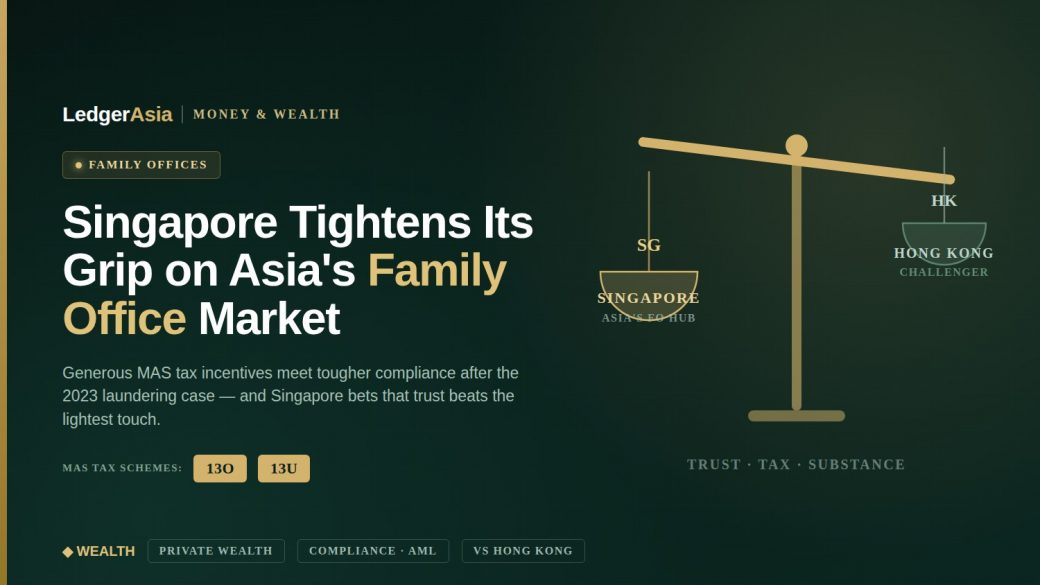
Singapore has spent the past decade building infrastructure for the world's wealthy. That work continues to pay off. The city-state remains the preferred base in Asia for family offices, the private firms that manage the fortunes of single families.
The appeal rests on a familiar mix. Singapore offers political stability, a respected legal system based on English common law, and a regulatory regime that wealthy families trust. It also sits within a few hours' flight of much of Asia's new money.
Why families choose Singapore
The Monetary Authority of Singapore (MAS) runs two tax incentive schemes that draw most family offices. They are known by their sections in the Income Tax Act, 13O and 13U. Both can exempt qualifying investment income from tax, provided a family meets conditions on assets, local spending, and hiring.
Those conditions have grown stricter. MAS now expects family offices to employ local staff, spend a minimum amount in Singapore each year, and allocate part of their assets to local investments. The intent is clear. Singapore wants the jobs and economic activity that come with managed wealth, not just the paper presence.
For families, the trade-off still works. A structure that anchors capital in a stable, well-regulated jurisdiction carries value beyond tax. It buys predictability.
The compliance turn
The environment is no longer frictionless. A money-laundering case in 2023 that involved billions in seized assets pushed Singapore to tighten its checks on the source of incoming wealth. Banks and regulators now apply heavier scrutiny to new arrivals.
That has lengthened the time it takes to set up and open accounts. Some advisers report that approvals now stretch over many months. The slower pace has not deterred serious applicants, but it has filtered out the casual ones.
Singapore appears willing to accept that trade. Reputation, in this business, is the product. A jurisdiction known for clean money and firm rules holds more long-term appeal than one that waves everyone through.
Competition from Hong Kong
Singapore does not operate without rivals. Hong Kong has moved to win back family offices, offering its own tax concessions and direct outreach to wealthy families in mainland China and beyond.
Hong Kong's pitch leans on proximity to China and deep capital markets. Singapore's leans on neutrality and a perception of distance from any single great power. For families weighing geopolitical risk, that neutrality carries weight.
The two centres are likely to split the market rather than one displacing the other. Families with strong China ties may favour Hong Kong. Those seeking diversification across Southeast Asia, India, and the wider region tend toward Singapore.
What sustains the lead
The number of single family offices in Singapore has risen sharply in recent years, supported by the tax schemes and the inflow of wealth from across Asia. Growth in newly created millionaires across the region continues to feed demand for these structures.
The deeper advantage is harder to copy. Singapore has built a full ecosystem around private wealth: private banks, law firms, fund administrators, tax advisers, and trust companies that understand cross-border families. A family office cannot run on tax breaks alone. It needs people who know how to operate one.
That depth took years to assemble. It gives Singapore a buffer that incentives elsewhere cannot quickly match.
The road ahead
The pressures on Singapore are real. Compliance costs are rising, and global tax coordination may erode some advantages of low-tax jurisdictions over time. Families and their advisers will keep testing whether the benefits justify the growing administrative burden.
For now, the answer favours Singapore. The city-state has chosen to compete on trust and substance rather than on the lightest possible touch. That choice fits the moment, as wealthy families weigh stability above all else.