

Thailand, Indonesia and Vietnam Sharpen Their Fight for EV Supply Chain Share
Thailand leans on assembly, Indonesia on nickel, and Vietnam on VinFast as the three economies compete to anchor EV supply chains amid a Chinese push.

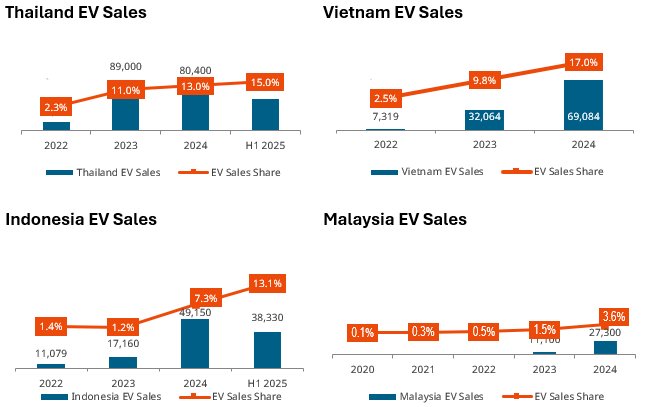
Southeast Asia's three largest car markets are no longer competing only for showroom sales. Thailand, Indonesia and Vietnam are now contesting the parts of the electric-vehicle business that decide where jobs, factories and supplier networks land for the next decade.
Each country is leaning on a different advantage. Thailand brings decades of vehicle assembly. Indonesia holds the raw materials that batteries depend on. Vietnam is pushing a domestic champion, VinFast, into markets well beyond its borders.
Thailand defends its assembly base
Thailand built its auto sector around Japanese manufacturers, and that legacy is now under pressure. Chinese EV makers have moved in aggressively, drawn by tax incentives and an existing supplier ecosystem.
The shift has consequences for incumbents. Honda's troubles in China are already rippling out to its parts suppliers, with some affiliates weighing whether to break ranks and serve other customers, according to Nikkei Asia. That dynamic matters in Thailand, where many of the same suppliers operate.
The risk for Bangkok is clear. If Chinese brands import more finished components rather than build them locally, Thailand keeps the assembly lines but loses the deeper supplier value.
Indonesia plays its resource card
Indonesia's pitch rests on geology. The country controls a large share of the nickel used in many battery chemistries, and it has used export rules to force processing onshore.
The strategy is to convert raw material leverage into battery manufacturing. Jakarta wants cell production, not just mining, which would anchor higher-value steps of the chain inside the country.
There are open questions about how durable that approach is. Battery costs are falling fast. Prices dropped 40% last year, according to Nikkei Asia, partly because an EV demand slump pushed manufacturers toward energy storage. Cheaper batteries change the math on where, and how, cells get made.
Vietnam exports a brand, not just parts
Vietnam's approach is the most unusual of the three. Rather than court foreign assemblers, it is backing VinFast, the carmaker tied to local conglomerate Vingroup.
The company is now testing demand abroad. VinFast-powered taxis have entered India through Green SM, the Vingroup-backed ride-hailing operator, marking the firm's first move beyond ASEAN, Nikkei Asia reported. The Indian taxi market is worth close to $1 billion and already crowded with Uber and Ola.
VinFast is also gaining ground closer to home. In the Philippines, EV sales have jumped as fuel prices climbed, and VinFast has led Tesla in that market, according to Nikkei Asia. The country relies heavily on imports, which sharpens the price impact of any fuel shock.
What the competition is really about
The contest is less about who sells the most cars this year and more about who captures the supply chain underneath.
Chinese automakers are the swing factor. BYD's regional expansion has run into friction elsewhere, including in Turkey, where authorities halted a tax break and warned of a clawback after construction stalled on a planned plant, Nikkei Asia reported. That episode is a reminder that incentive-driven investment can reverse quickly.
For Southeast Asian governments, the lesson is that subsidies alone do not lock in a supply chain. Thailand needs its supplier base to stay relevant as the powertrain shifts. Indonesia needs battery demand to hold up even as cell prices fall. Vietnam needs VinFast to survive in markets where established rivals already dominate.
The three strategies could end up complementary rather than purely competitive. A regional chain that pairs Indonesian materials, Thai assembly and Vietnamese brands is plausible. Whether national policies allow that integration, or fragment it, will shape who benefits as the EV transition accelerates across the region.