

Nolan’s Odyssey: A $250M+ IMAX gamble on ancient myth as blockbuster
Christopher Nolan is shooting Homer's *Odyssey* as the first feature entirely on IMAX cameras. The production likely cost $250–300M across six countries, betting that ancient myth can anchor a theatrical blockbuster in a market increasingly skeptical of non-IP franchises.

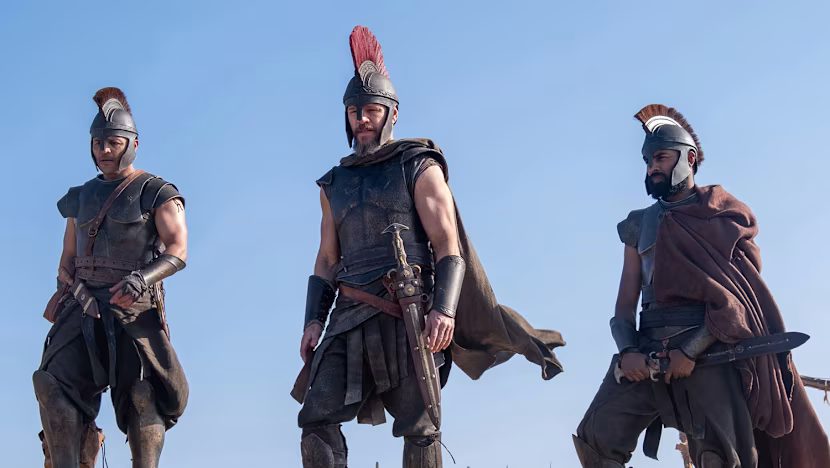
Christopher Nolan is adapting Homer's The Odyssey as a large-format feature, becoming the first filmmaker to shoot an entire narrative film using IMAX cameras, according to production details released this month. The project represents a significant capital commitment to theatrical cinema at a time when legacy studios are hedging bets toward streaming.
The production shot across six countries—Morocco, Greece, Italy, Iceland, Scotland, and the United States—over 91 days, suggesting a budget likely in the $250–300 million range, consistent with Nolan's recent films Oppenheimer (reported $100M) and Dunkirk ($150M). No production budget has been disclosed.
The cast includes Matt Damon as Odysseus, Anne Hathaway as Penelope, and an ensemble with Tom Holland, Robert Pattinson, Lupita Nyong'o, Zendaya, and Charlize Theron. Nolan told producers he pursued the project because the 2,800-year-old epic "has never been adapted as a modern blockbuster," framing the adaptation as a gap in the market rather than a cultural imperative.
From a capital-allocation perspective, the bet is unconventional. The film depends entirely on theatrical IMAX exhibition at a moment when box office recovery remains uneven. Oppenheimer (2023) grossed $952 million worldwide, benefiting from an established audience for Nolan's brand and wartime drama's proven appeal. Dunkirk (2017) earned $527 million. Neither had to justify their premise to audiences unfamiliar with the source material's cultural footprint in Gen Z and younger millennial demographics.
The Odyssey carries higher narrative risk: audiences under 30 have minimal familiarity with Homer. The production's reliance on practical effects—including 11-meter-tall Trojan Horse constructs and a 360-degree Troy set spanning over 10,000 square meters in Ait Benhaddou, Morocco—signals confidence in differentiation. The newly developed IMAX cameras justify the scale rationale to exhibitors, though whether technical innovation alone drives ticket sales remains untested.
No distribution window, release date, or projected budget recovery has been announced. Warner Bros. is the presumed distributor; the studio has not disclosed financial terms or confidence metrics. The film's commercial success will largely hinge on whether a 10,000-minute-per-second action spectacle can convert audience curiosity into opening weekend performance sufficient to justify the capital outlay across IMAX-capable theaters globally—a footprint smaller than standard multiplexes and dependent on premium pricing to offset lower seat volume.