

Kyoto’s Gion Festival draws record crowds despite extreme heat, AI crowd monitors manage surge
Kyoto's Gion Festival drew record crowds on July 17 despite temperatures reaching 38°C—the second-highest ever recorded during the event. Real-time AI crowd monitoring systems managed congestion by alerting security and updating LED displays with detour suggestions.

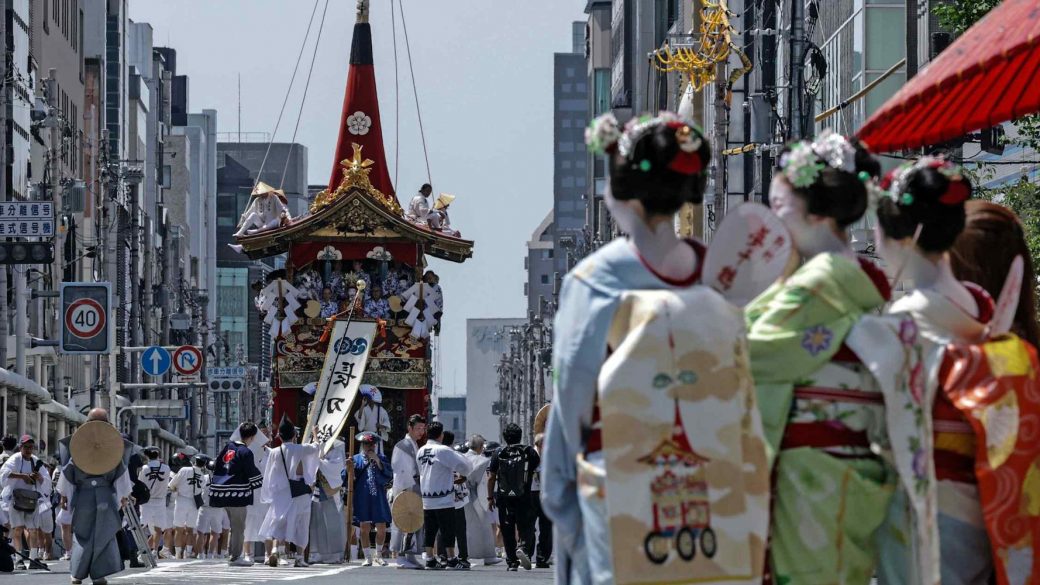
Kyoto's Gion Festival attracted thousands of spectators on July 17 for Saki Matsuri, the first of the month's grand float processions, even as temperatures soared to near 40 degrees Celsius—the second-highest ever recorded in the city during the festival's history.
Twenty-three elaborately decorated floats, traditionally called "moving museums," processed through the former capital's main streets starting around 9 a.m., with the lead float, Naginata-hoko, departing from the Shijo-Karasuma intersection. Spectators lined the route, recording the parade music (gion-bayashi, played on gong, flute, and drum) on phones and cameras.
A central draw remains tsujimawashi, the dramatic 90-degree turns that float handlers execute at intersections. Workers lay bamboo poles under the wheels, pour water over them, and pull ropes while shouting "Yo-itose"—translating roughly as "Ready? Heave!"—to swing the massive wheels through the corner. The technique creates visible strain on the structures and requires coordinated effort from dozens of handlers.
The heat proved the day's defining challenge. According to the Kyoto Local Meteorological Observatory, temperatures reached 38°C by 3 p.m. on July 17. Many attendees relied on parasols and hand fans to manage conditions. On July 15, Shijo Street experienced severe pedestrian congestion around 6 p.m., prompting intervention through LED displays at intersections that showed "Heavy congestion ahead" warnings and suggested detour routes.
Behind the visible crowd management lay an AI-powered system. Real-time cameras placed at expected congestion points feed footage to algorithms that monitor crowd density continuously. When density exceeds predetermined thresholds, the system sends alerts to on-site security staff and automatically updates LED displays with new routing suggestions. This marks a shift toward algorithmic crowd control at Japan's cultural events, reducing reliance on manual observation alone.
The Gion Festival operates as an annual ritual of the Yasaka Shrine, a roughly 1,370-year-old Shinto site in Kyoto's Gion district. Festival records trace its origins to the Heian period (794–1184), when portable shrines were paraded and residents sought relief from epidemics. The month-long observance includes a second major procession, Ato Matsuri, scheduled for July 24, which will feature 11 additional floats.
The combination of historical tradition and modern crowd-management technology highlights how Japan's oldest festivals are adapting to both climate stress and rising attendance. Extreme heat events have become more frequent in Kyoto during summer months, yet the festival continues to draw larger crowds each year, pushing infrastructure and safety systems to new limits.