

ASEAN Exporters Prepare for a Harder Phase of Trade Fragmentation
Tariffs, export controls, and bloc-driven supply chains are reshaping global trade. ASEAN's export-heavy economies are preparing for a more contested phase.

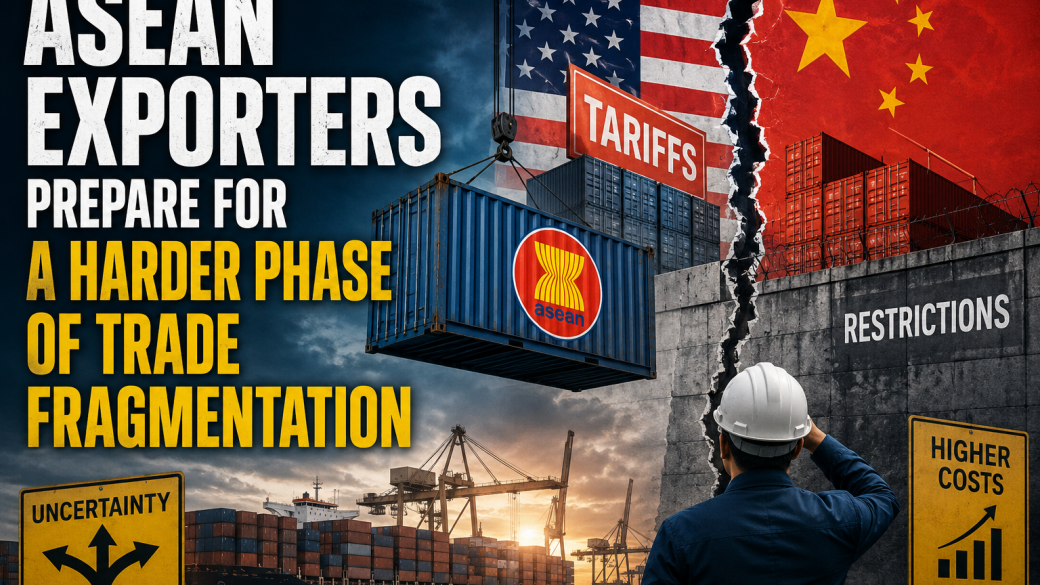
Southeast Asia's exporters are entering a period where the rules of global trade no longer point in one direction. Tariffs, export controls, and rerouted supply chains are reshaping how goods move, and ASEAN economies sit close to the center of that shift.
The World Trade Organization, in its 2025 trade outlook, frames the core problem as fragmentation. Trade is increasingly organized around geopolitical blocs rather than open, rules-based flows. For a region that built its growth on plugging into global value chains, that change carries real cost.
Why ASEAN feels this first
Most ASEAN economies run trade-to-GDP ratios far above the global average. Singapore, Vietnam, Malaysia, and Thailand depend on cross-border flows for a large share of output. When trade barriers rise between major partners, the effects reach Southeast Asian factories quickly.
The region also occupies a specific role in supply chains. Many firms route intermediate goods through ASEAN before final assembly or onward shipment. That position became more valuable as companies diversified away from concentrated manufacturing bases. It also makes the region exposed when origin rules and tariff lines tighten.
The shift from efficiency to security
For three decades, supply chains chased the lowest cost. The current phase prioritizes resilience and political alignment. Governments now treat semiconductors, batteries, and critical minerals as strategic assets, not ordinary commodities.
That reordering creates openings and risks at the same time. ASEAN can capture relocated production as firms spread their bets. But the region also risks getting caught between rule sets that demand companies pick a side.
Export controls add another layer. When advanced economies restrict shipments of certain technologies, ASEAN manufacturers that rely on those inputs face delays and compliance costs. Tracking where components originate has become a routine operational burden rather than a back-office task.
A more fragmented trade map
The WTO outlook describes a world where trade growth holds up but flows reorganize along bloc lines. Goods still move, but increasingly within trusted groupings rather than across them. For ASEAN, that means the value of being neutral may decline if partners insist on alignment.
The region has hedged through overlapping agreements. The Regional Comprehensive Economic Partnership links ASEAN with China, Japan, South Korea, Australia, and New Zealand. Several members also belong to the CPTPP, which connects them to markets across the Pacific. These frameworks give exporters multiple channels when any single corridor narrows.
That layered approach has limits. Trade deals lower tariffs, but they do not resolve disputes over technology transfer, subsidies, or national security carve-outs. Those are the areas where current friction concentrates.
What exporters are doing now
Firms are responding in practical ways. Many are mapping their supply chains in greater detail to understand exposure to specific countries and inputs. Some are building duplicate sourcing so a single disruption does not halt production.
Manufacturers are also investing in compliance capacity. Rules of origin determine whether a product qualifies for preferential tariffs, and small classification errors can erase the benefit. Getting that documentation right has become a competitive factor, not a formality.
Governments across the region are adjusting too. Several have signed new bilateral arrangements and pushed to deepen intra-ASEAN trade, which remains modest relative to the region's external links. Stronger internal markets would offer a buffer against external shocks, though closing that gap has proven slow.
The harder questions ahead
The central uncertainty is how far fragmentation goes. A moderate version leaves ASEAN as a connector between blocs, capturing trade that reroutes through the region. A sharper version forces clearer choices and squeezes the space for neutrality.
The outcome will depend less on ASEAN itself than on decisions made in Washington, Beijing, and Brussels. That is the structural difficulty for a region whose prosperity rests on access it does not fully control. For now, exporters are planning for a trading system that is more contested, more political, and less predictable than the one that powered their rise.