

AMD launches Helios AI rack to challenge Nvidia’s dominance in data center inference
AMD unveiled Helios, a rack-scale AI system designed to compete with Nvidia's high-end data center offerings. The system has already secured commitments from OpenAI, Meta, Microsoft, Anthropic, and Oracle.

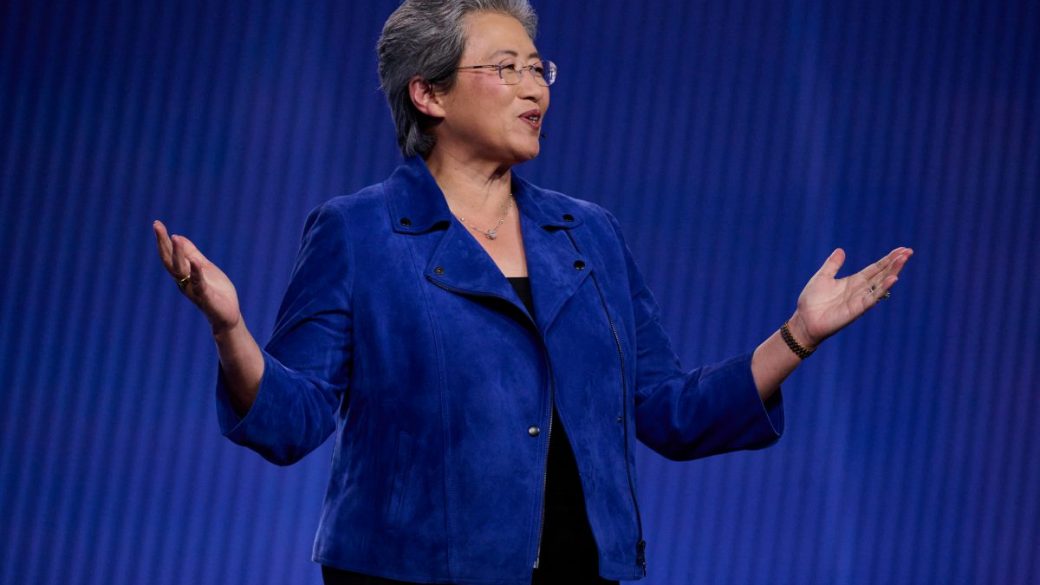
AMD unveiled Helios, a rack-scale AI system designed to compete directly with Nvidia's offerings in high-performance data center computing. The system was presented Thursday at the company's Advancing AI conference in San Francisco by AMD Chair and CEO Lisa Su, who described it as the "highest-performance AI rack" built for training and running frontier AI models at scale.
Helios will be deployed at gigawatt capacity by major AI companies. According to reporting from The Register, the system beats Nvidia's Vera Rubin on several performance metrics. AMD has already secured commitments from multiple large customers: OpenAI, Meta, Oracle, Anthropic, and Microsoft have announced plans to deploy Helios. Microsoft CEO Satya Nadella confirmed Monday that Azure infrastructure would expand to include the system. Separately, Anthropic and AMD announced Wednesday a strategic partnership to deploy up to two gigawatts of GPUs via Helios.
The company also introduced Venice-X, a CPU for data centers handling high-compute workloads, scheduled to launch in 2027.
Su used the announcement to discuss broader chip industry trends. She projected that by 2030, the AI accelerator market will reach approximately $1.4 trillion, a figure that would make it nearly equivalent to the entire semiconductor industry today. This expansion, she said, is driven by the rise of agentic AI, which requires multiple computational steps including reasoning, tool calling, and data access. "When you ask the agent to do something, it actually has dozens of steps, and it has to reason, and it has to call tools, and it has to access data, and it has to keep doing it over and over until it solves the problem," Su explained.
Su predicted that GPUs will comprise the majority of the accelerator market through 2030, citing the relative immaturity of AI algorithms and the continued evolution of workload types, both of which favor programmable silicon solutions.
Helios was first revealed in 2025 and demonstrated at CES 2026 in January. The company expects to begin shipping it later in 2026.