
Trump’s 2025 Disclosure Shows $2.2B in Income, With $1.4B Traced to Crypto Tokens
Trump's 2025 financial disclosure reports $2.2B in income, with $1.4B traced to crypto tokens like World Liberty Financial and the $TRUMP memecoin.

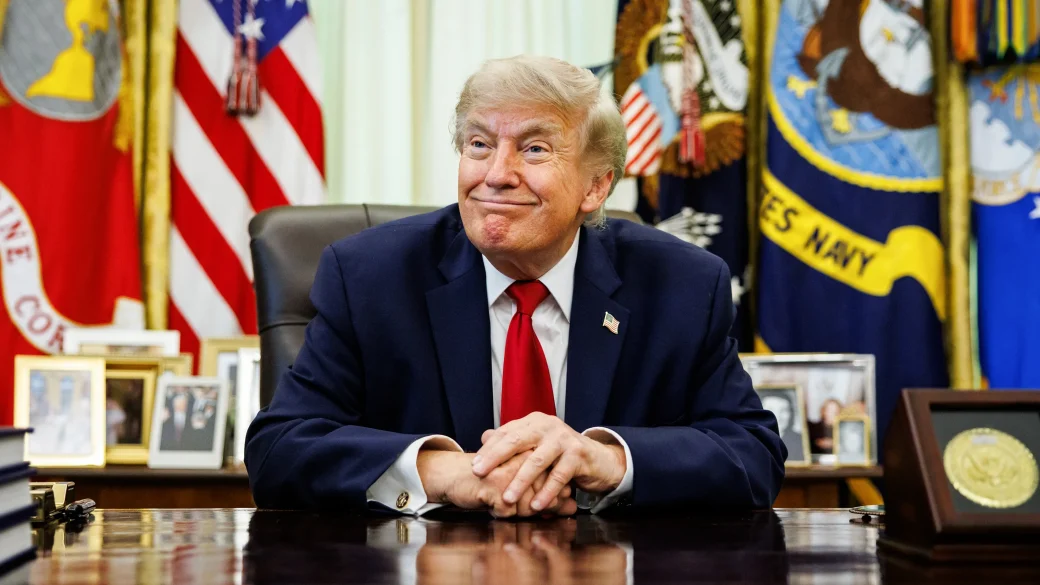
President Donald Trump reported more than $2.2 billion in earnings for 2025 in a 927-page personal financial disclosure released this week, up from roughly $622 million in 2024, according to reporting by The New Yorker. More than $1.4 billion of that total traces to crypto tokens and related investments, the single largest driver of the year-over-year increase.
The filing breaks the crypto income into two main buckets. Roughly $800 million is associated with World Liberty Financial, the token venture Trump co-founded with Steve Witkoff and their sons. A further sum exceeding $600 million appears to come from the partnership behind the $TRUMP memecoin, a token that carries no claim on any underlying business and that Trump began selling in the days before his inauguration.
Where the money came from
For an analyst reading the disclosure, the structure matters more than the headline number. World Liberty's tokens conveyed no ownership stake, could not initially be resold or traded, and entitled holders only to an undefined future governance vote, per The New Yorker. The fine print, the outlet reported, directed 75 percent of token-sale proceeds to Trump and his family. That is a distribution mechanism, not an operating business with revenue, margin, or a comparable multiple to benchmark against.
The disclosure also appears to acknowledge a previously undisclosed transaction: roughly $263 million tied to the sale of a half interest in World Liberty Financial, reported as $66 million in "equity sale" and $197 million in "capital contribution" without naming the counterparty. The Wall Street Journal previously reported that the buyer was the ruling family of the United Arab Emirates, according to The New Yorker.
Separately, the advocacy group Citizens for Responsibility and Ethics in Washington calculated that Trump disclosed more than $117 million from business deals outside the U.S., much of it from Persian Gulf real-estate development, up from about $40 million a year in foreign revenue during his first term. The filing also records more than $80 million from settling civil lawsuits against media companies.
The counterparties tell the story
The capital flow behind these numbers is concentrated and, in several cases, tied to counterparties with regulatory exposure. Justin Sun, the crypto entrepreneur, invested $30 million in World Liberty in late November 2024, then bought $75 million in World Liberty tokens total plus $200 million in $TRUMP, according to The New Yorker. At the time, Sun faced federal fraud and market-manipulation charges. Regulators dropped those charges in March 2026 in exchange for a $10 million fine.
The relationship soured quickly. In April, Sun sued World Liberty for fraud, alleging he was pressured to buy $200 million of stablecoin and then had his tokens frozen while other holders were permitted to trade, The New Yorker reported. World Liberty countersued for defamation. World Liberty's profits were also supported by a partnership with Binance, whose founder Changpeng Zhao received a presidential pardon last fall.
The red flag: who is left holding the tokens
The clearest tension in the disclosure is between the profits accruing to the issuer and the position of the buyers. Trump's sons Eric and Donald Jr. repeatedly urged retail investors into the family's crypto ventures. In one speech, Donald Jr. told "average" Americans to "buy as much as you can," per The New Yorker, and both have predicted bitcoin would reach $1 million, versus a 2024 peak near $125,000.
A token with no ownership, no resale mechanism at issuance, and 75 percent of proceeds routed to the sponsor is, structurally, a transfer of capital from buyer to issuer. The disclosure quantifies how much of that capital moved. It does not describe any return mechanism for the buyers.
Asia angle
The capital flows documented here run notably through Asia and the Gulf. Sun, described as Chinese-born, accounts for at least $275 million of the token purchases named in the reporting. Binance, the counterparty behind part of World Liberty's profits, is one of the largest crypto exchanges serving Asian markets. The reported $263 million UAE-linked transaction and the Gulf real-estate income point to sovereign and family-office capital from the region flowing toward U.S.-linked crypto and property assets. For investors tracking regional capital deployment, the disclosure is a rare itemized look at where that money landed.
The filing is already dated. It excludes a Boeing 747 valued at roughly $400 million that The New Yorker reported was gifted by the Emir of Qatar and unveiled this week as the new presidential aircraft.