
Trump’s Freedom 250 Turns America’s Semiquincentennial Into a Corporate Sponsorship Exercise
Trump's Freedom 250 fair on the National Mall listed Salesforce, Boeing, Lockheed Martin, and U.F.C. as sponsors, blending federal anniversary with corporate expo.

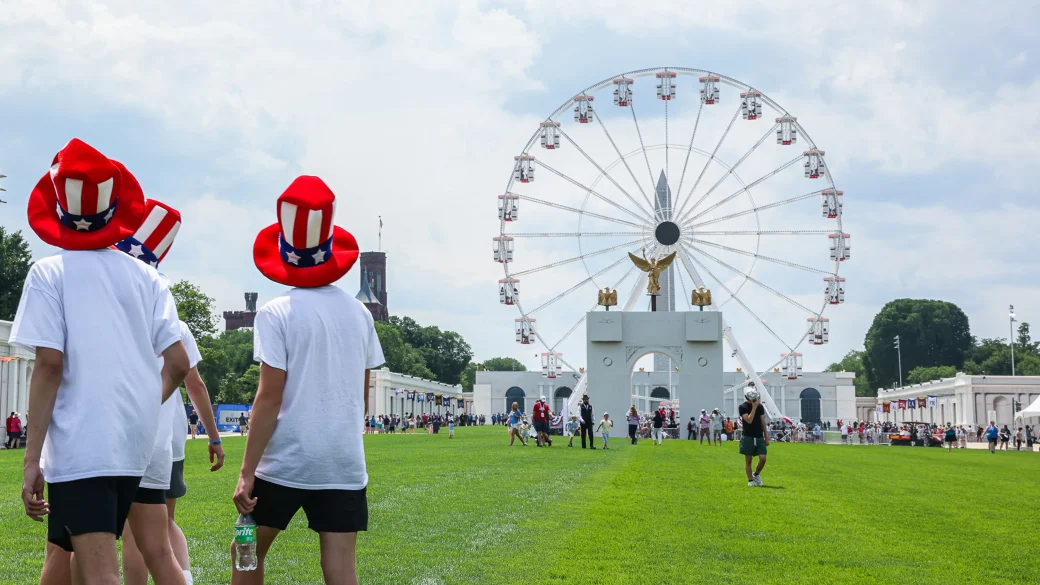
President Donald Trump used the run-up to the United States' two-hundred-and-fiftieth anniversary to stage the Great American State Fair on the National Mall, an event whose commercial architecture read less like a national celebration than a branded expo, according to reporting by The New Yorker.
The fair operated under Freedom 250, the anniversary program Trump created after diverting funds from America250, a bipartisan, congressionally mandated nonprofit originally tasked in 2016 with planning the semiquincentennial. Trump signed an executive order early in his term making Freedom 250 the primary branding for the anniversary, The New Yorker reported.
The Sponsor Roster
The money behind the event was explicit. A light-up screen at the venue listed sponsors including Salesforce, Boeing, Lockheed Martin, and U.F.C., according to the report. Defense contractors and military recruiters filled table after table, and the Department of War booth reportedly drew the longest line at the fair.
For the corporate names attached, the arrangement offers direct association with a federal anniversary program. Boeing and Lockheed Martin both carry substantial exposure to U.S. defense procurement, and a recruiting-and-contractor-heavy fair aligns with that customer base. Salesforce and SpaceX also held booth space alongside the First Amendment display, per the report. The account did not disclose sponsorship fees or the financial terms of any participation, and none of the figures behind the arrangements were made public.
Trump Accounts Get Prime Placement
The first booth the reporter visited advertised Trump Accounts, described as tax-advantaged investment accounts for children seeded by the federal government. The marketing framed the accounts as free, comparing them to the complimentary charging stations positioned below the signage.
The placement is notable from a capital-flow standpoint. A federally seeded child investment vehicle receiving front-of-house positioning at a taxpayer-adjacent event ties public money to a branded financial product. The report did not specify the seeding amount per account, the custodian, or the fee structure, all of which would determine whether the product functions as a low-cost savings vehicle or carries meaningful drag on returns.
Partisan Split Reduced Participation
Several states declined to send representatives, citing disagreements with what they viewed as the event's partisan mission, according to The New Yorker. That reduced participation is a signal worth watching for any commercial partner: a national program that loses state-level buy-in narrows its reach and its audience.
The fair's content leaned heavily toward Trump-branded material. The First Amendment appeared as part of a promotion for Truth Social, the President's social network, and a State Department exhibit on the history of the U.S. passport ended with a prototype featuring Trump's likeness, the report said. The main-stage event was postponed because of bad weather.
The Asia Angle
One exhibit placed a stand about Micron chips beside a CSPAN American-history timeline, and a TikTok booth invited visitors to take selfies, according to the report. Both names carry direct relevance to Asia-Pacific capital flows. Micron's memory business is deeply exposed to Asian supply chains and to U.S. export-control policy toward China, while TikTok's presence at a federally branded event sits against the backdrop of ongoing U.S. scrutiny of its ownership. Their appearance signals that companies operating at the center of U.S.-Asia technology tension were willing to attach themselves to the program, though the report did not detail the terms of that participation.
For investors and corporate watchers in the region, the event underscores how proximity to the current administration's branding initiatives is being priced as a relationship worth cultivating, particularly for firms navigating U.S. regulatory exposure.